Introduction
DIME lets you go long or short on Nvidia and Bitcoin with up to 1000× leverage from a $0.10 margin, settled in USDG on Robinhood Chain.
In 30 seconds
- Pick a side. Long if you think the price goes up, Short if you think it goes down.
- Pick a size. A margin from $0.10 to $10 and a leverage up to 1000×. Every trade is capped at $5,000 of exposure, so margins above $5 get less leverage. Your margin is the most you can lose.
- Sign once. The house takes the other side, first come, first served. DIME pays the gas.
- Close any time at the verified price. If you lose against the house, you earn DIME.
An example. A $0.10 long on Nvidia at 1000× controls $100 of NVDA. If NVDA rises 0.05%, that's $0.05 gross and you're paid about $0.031: there's no fee, but small wins are paid on a curve (below). If NVDA falls 0.06%, the position is liquidated and you lose the $0.10.
Why the price matters. At 1000×, a 0.1% move is the whole trade, so DIME builds its price from Hyperliquid's order books (BTC also checked against six exchanges), signs it, and has a contract on Robinhood Chain check it on every open and close. Anyone can recompute it from the public log.
What's next. Nvidia and Bitcoin are the first markets. More stocks and majors follow as the house grows.
Using DIME, step by step
From first visit to your first trade takes a couple of minutes. These are phone screens; the desktop layout has the same steps.
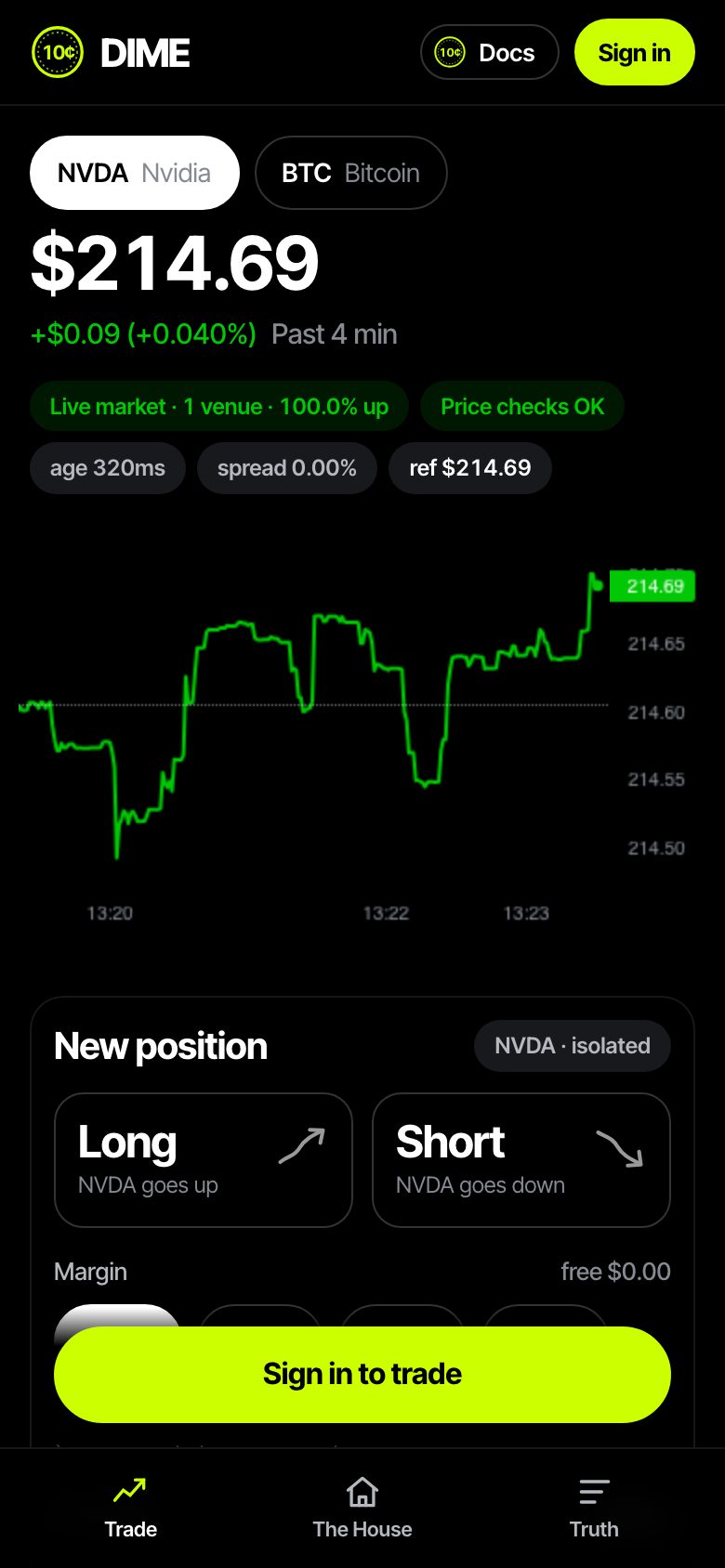
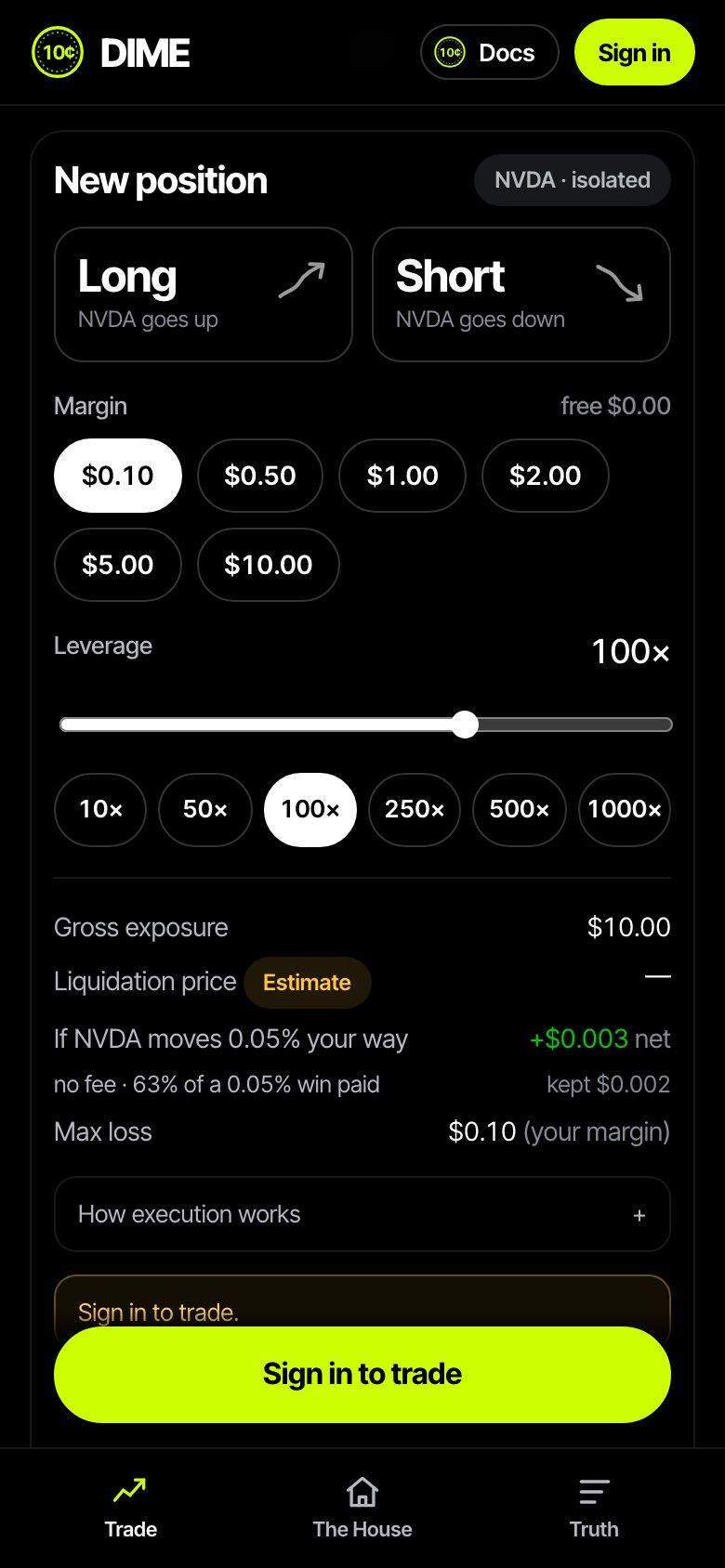
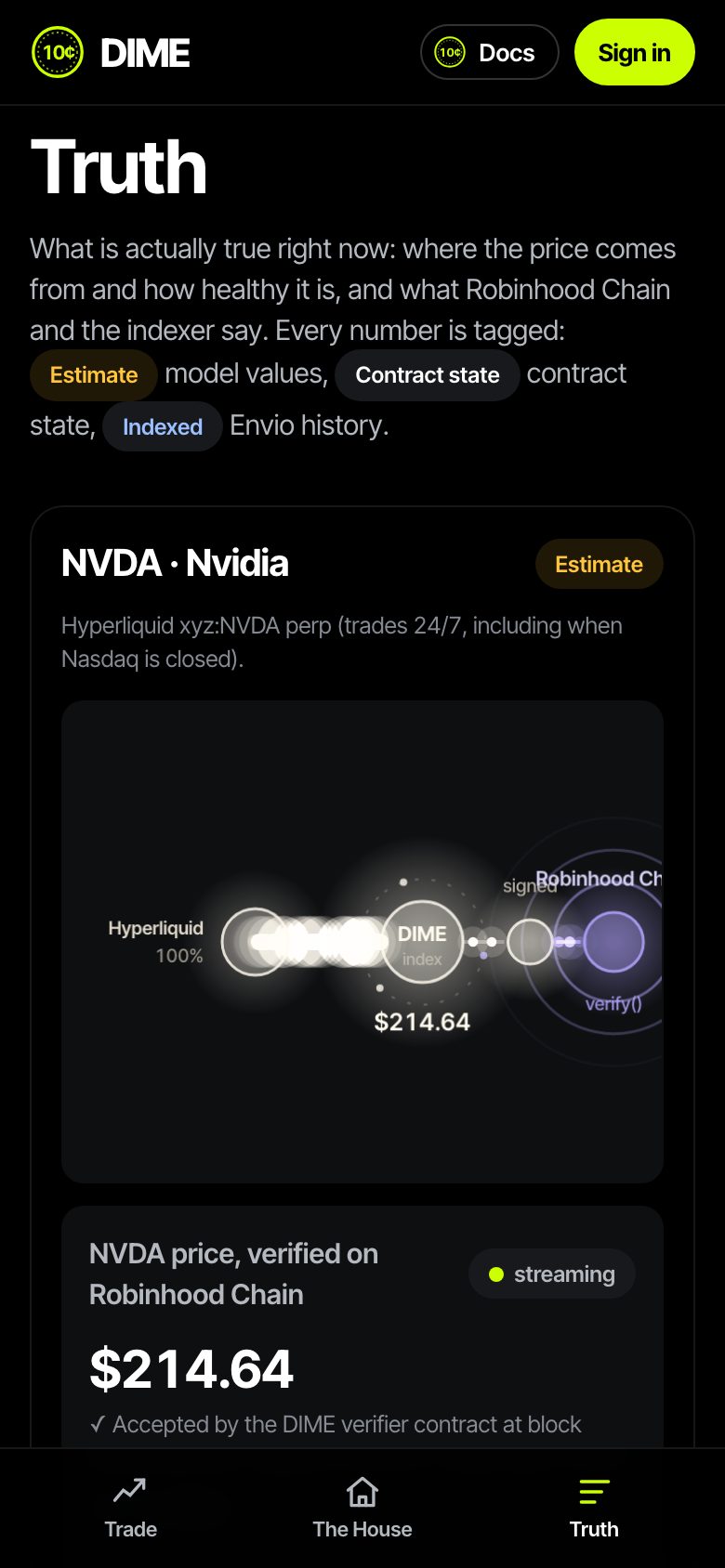
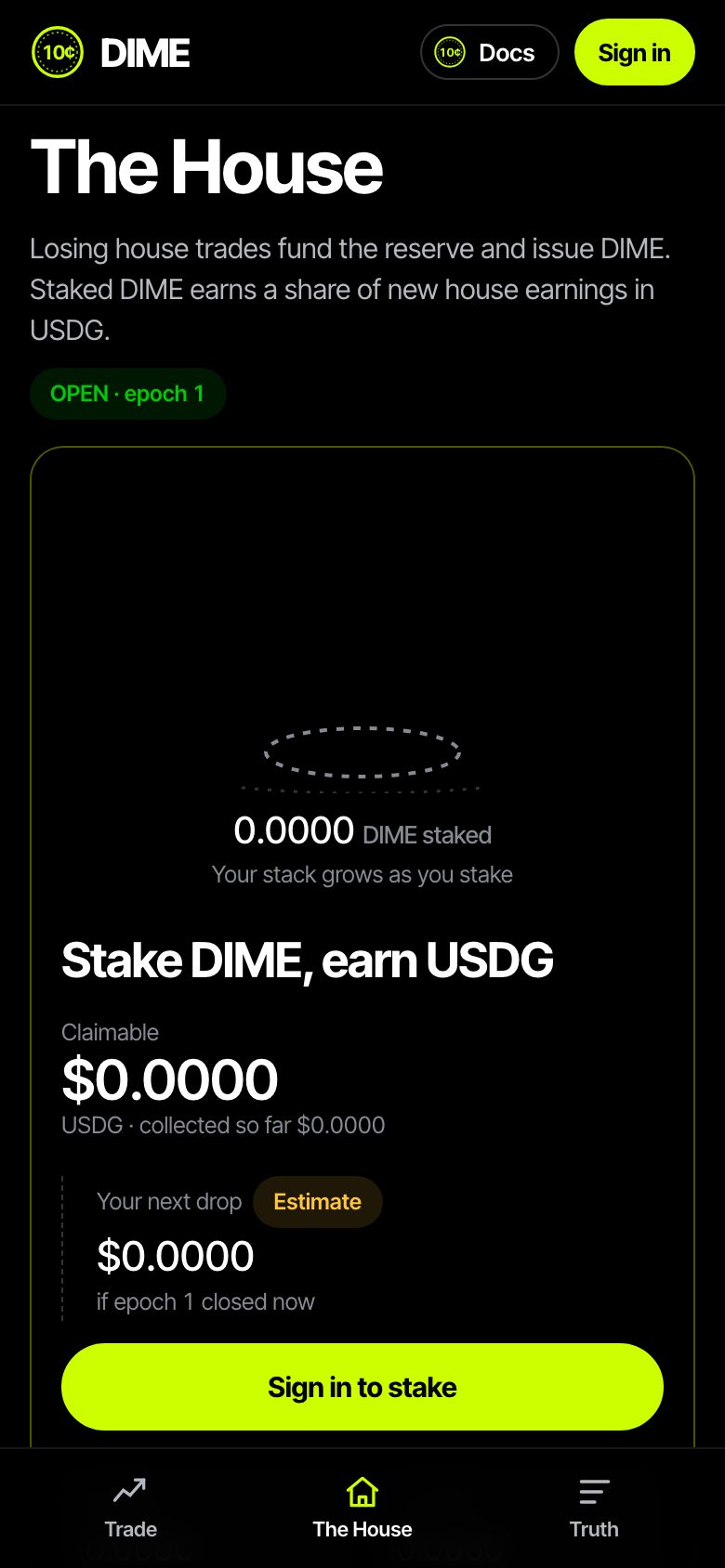
How a trade works
- Margin is what you put in and the most you can lose. Leverage multiplies it into your position size: $0.10 at 1000× is $100 of NVDA or BTC.
- $5,000 exposure cap. No trade can be bigger than $5,000, so leverage depends on margin: 1000× at $5, 500× at $10. When the house is full, new trades wait in a queue.
- Liquidation. 4 bp (0.04%) before your margin would run out: a 0.06% move against you at 1000×, 0.46% at 200×, 0.96% at 100×. The position closes and your whole margin goes to the house. There are no stop-loss or take-profit orders: close the position yourself to keep part of it.
- Pair your browser. With MetaMask or another wallet, sign once to pair this browser and trades skip the wallet pop-up for 30 days. The browser keeps a trading-only key: it can open and close your trades, never withdraw. Unpair this browser, or every browser and bot at once, from your account.
- The house takes the other side of every trade, first come, first served: when it is full, new trades wait in line and smaller ones can fill gaps first. For each trade it sets aside 4× your margin to cover your winnings, so the largest margin on offer depends on how much of its reserve is free.
- No fees. No fee to open or close, no funding, no spread, and DIME pays the gas. A win of m bp is paid m × m ÷ (m + 3) bp, so at most 0.03% of any win is kept: you get 50% of a 0.03% win, 77% of 0.1% and 97% of 1%. It is the same however long you hold.
- Price tolerance. Set for you and shown before you sign. If the price moves past it before your trade lands, nothing opens and your margin stays free.
- Your free balance can always be withdrawn back to your wallet.
The price
- Nvidia is priced from Hyperliquid's xyz:NVDA perpetual (trade.xyz), which trades 24/7. While Nasdaq is open it follows the real stock; on weekends and holidays it follows Hyperliquid's own market, within limits. New NVDA positions pause for 15 minutes before and 30 minutes after the Sunday-evening reopen, after a 2% move in 5 minutes, and when the book is thin or wide. The app shows when weekend pricing applies.
- Bitcoin uses Hyperliquid's BTC top-of-book price, signed on every update (at most every 50 ms), and checked against Hyperliquid's mark price, its book depth and a liquidity-weighted median of six exchanges (Binance, OKX, Bybit, Hyperliquid, Coinbase and Kraken). If Hyperliquid strays more than 0.03% from that median, the median is signed instead. If too few venues are fresh, new trades pause.
- Orders fill at the next signed price after they arrive. The verifier contract on Robinhood Chain checks the signature whenever a trade opens or closes.
- Every signed price is published with all of its inputs at api-alpha-dime.rndm.io/feed/audit (Nvidia: /feed/nvda/audit), so anyone can recompute it. Watch it live on Truth.
DIME and staking
- A trade that loses against the house earns DIME, an on-chain token, on net losses only: 11 DIME per $1 at 1000×, scaled by leverage (5.5 at 500×). Early on it's boosted: 4× until traders' total losses reach $10k, then 2× to $50k and 1.5× to $200k, with a further 2×, 1.5× and 1.25× on liquidations. Issuance is capped each daily epoch.
- Earned DIME is staked for you and held by the protocol contract, so it doesn't show in your wallet. See it on The House.
- Staked DIME starts earning at the next epoch. It shares part of new house earnings, paid in USDG, once earlier house losses are recovered. Some epochs pay nothing.
- DIME can't be transferred until a publicly scheduled date. It is not a refund and has no guaranteed value.
Where the money goes
- Fees. None. The house earns from the curve on wins (at most 0.03% of the move) and from liquidations. No spread, no funding.
- House trades. When you lose against the house, your margin goes into the house reserve. When you win, the reserve pays your profit on the curve.
- Matched trades. The loser pays the winner directly. The house only takes the curve's cut of the winner's profit.
- Stakers get 30%. Each daily epoch, once earlier house losses are recovered, 30% of the house's new earnings are paid in USDG to staked DIME. Some epochs pay nothing.
- The operator keeps 70%. The rest stays in the house reserve, which is owned by the operator (RNDM). It is the operator's capital and earnings, and it backs every house trade.
- What the operator can withdraw. Only house reserve above what open positions need, and never while the protocol is insolvent. Every withdrawal is a public
ReserveWithdrawnevent on-chain. - What the operator can't touch. Your free balance and your locked margin. The contract only pays them out to you, when you withdraw or when a trade settles.
Risks
DIME is experimental software that uses real money. You can lose your margin on every trade, and everything you deposit.
| Risk | What can happen | What limits it |
|---|---|---|
| Leverage | At 1000×, a 0.06% move against you liquidates the position and you lose your whole margin. It can happen within seconds. | Your margin is your maximum loss on each trade (isolated margin). The liquidation price is shown before you sign. |
| The price | Prices are signed by DIME's own pricing service. A wrong or delayed price could open, close or liquidate at the wrong level. | Every signature is checked on-chain and every price is published with its inputs. BTC is checked against six exchanges; new trades pause if a feed degrades. It is not yet an independent oracle. |
| Nvidia outside market hours | NVDA trades 24/7 on Hyperliquid, but when Nasdaq is closed (weekends, holidays) its price comes from Hyperliquid's own market and can gap when the real stock reopens. | New NVDA positions pause around the reopen and when the book is thin; the app says when weekend pricing applies. |
| Smart contracts | The contracts are new and unaudited. A bug could lose deposited funds. | Source is public on GitHub; deposits are capped at $25 per wallet during the alpha. |
| The house | The house reserve is small. It may close a position early if your gain nears what it reserved for you, and new trades queue when it is full. | Every trade is capped at $5,000 of exposure; the house reserves 4× your margin per trade and only fills what it can cover. Its reserve and results are on the House page. |
| Operator control | The admin can change settings and pause trading. DIME's relayer submits trades and the keeper liquidates. | Each order is signed against a specific settings version. The guardian can only reduce risk; reopening needs the admin. |
| Outages | If DIME's servers or Robinhood Chain are down, you may be unable to open or close a position in the app. | Funds stay in the contract, and your free balance can be withdrawn straight from your wallet. |
| Bridging | USDC deposited from Arbitrum is moved by Relay, a third-party bridge. A failed delivery is refunded on Arbitrum. | Relay checks the deposit before you pay; nothing reaches DIME until it arrives. |
| DIME | DIME may earn nothing, and new issuance dilutes existing holders. It is not a refund and has no guaranteed value. | Issuance is capped per epoch; payouts only come from new house earnings after earlier house losses are recovered. |
| Stablecoin and network | USDG could lose its peg; Robinhood Chain could halt or reorganise. | Outside DIME's control. |
| Your wallet | Whoever controls your wallet controls your funds. | Email and Google wallets are run by Privy; external wallets stay under your keys. |
| Eligibility | DIME is not available in some places, including the United States, the United Kingdom and Canada. | See the Terms of Use. |
Alpha limits
- Invite-only, up to 50 wallets.
- Deposits up to $25 per wallet in total. Margin $0.10–$10. Leverage up to 1000×, with every trade capped at $5,000 of exposure.
- The house reserve starts small and grows with the alpha. Trades it can't cover yet wait in line.
Contracts (Robinhood Chain mainnet)
- DIME protocol
- 0xA6B7fF03cCe1342AAE8c898FAd63BD0ccaCA9de7 ↗
- DIME token
- 0x62018964b8115a1511df8Da1609542f40f449606 ↗
- Price verifier
- 0x01858E70DF3C0c6D5AF80b44E460e5479b4ee5fb ↗
- USDG
- 0x5fc5360D0400a0Fd4f2af552ADD042D716F1d168 ↗
Source code: github.com/vijayengineer/dime-v2. Verification on Robinhood Chain explorer is pending.